
Compare the Value Types in Lee County Records
"A Lee County property value" is not one number but several. It may be an assessed figure, a fair-cash-value estimate, a deed consideration amount, or a private market opinion. Each answers a different question. Kentucky law starts from fair cash value under KRS 132.450, while the deed records what the parties themselves reported for a transfer. Neither figure alone tells you what a future sale might bring."
| Value | What It Is | Where |
|---|---|---|
| Fair cash value | The Kentucky assessment standard for a voluntary sale | Lee PVA assessment |
| Total assessed value | The dated assessment figure shown for the parcel | PVA card and tax-year record |
| Last sale or consideration | The reported amount on a deed or transfer field, which may not be market price | County Clerk deed; PVA if verified |
| Land and improvement | The allocation between land and structures when displayed | Lee PVA card |
Do not invent a Lee County assessment ratio. The PVA publishes no sample card or county ratio report online. Compare values only when the same parcel, the same type of value, and the relevant dates are all clear.
How Kentucky Fair Cash Value Shapes Lee Assessments
The Kentucky Department of Revenue assessment overview lays out the sales-comparison, cost, and income approaches to value. The Lee Property Valuation Administrator applies that same fair-cash-value standard to local assessments. Farm land may qualify for agricultural value instead. Homestead treatment is a separate statutory program with its own rules. The Revenue overview is the statewide source behind these Lee County property-value terms.
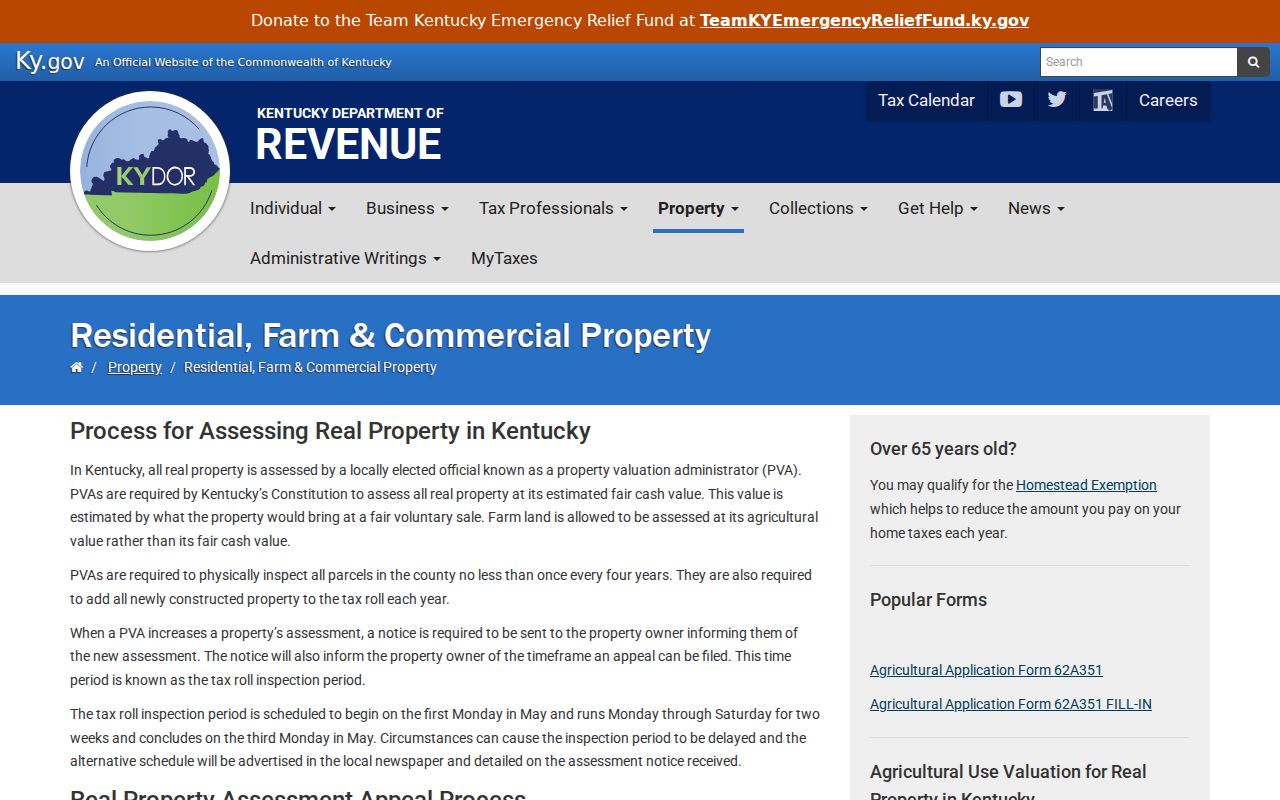
Use that state guidance to read a dated Lee PVA card. But rely on the card itself for the parcel's actual class and figures. The Department of Revenue revalues property annually. It physically inspects property at least once every four years. That does not mean each Lee parcel gets a fresh private appraisal every year. The assessment system simply maintains and reviews values on the statewide cycle.
Request the Lee PVA Value Card by Year
The entry at Lee County PVA redirects to qPublic, so the card itself comes from the office. Contact Elizabeth Roach's office at 667 Tip Top Road in Beattyville, call (606) 464-4105, email leepva@mikrotec.com, or send a narrow written request. Supply the situs address and the APN with punctuation intact. Ask for the tax year, land value, improvement value, total assessed value, property class, exemption, acreage, and any physical-inspection or effective date. Request the last sale date or price only if the card actually shows one. Also ask the retrieval date and whether the card is current for that assessment year. The PVA posts no online fee schedule or historical-card archive.
Insider tip. Save the year with every figure. A bare dollar amount cannot show whether a value predates a transfer, improvement, or appeal.
Estimate a Lee County Property Value from Official Records
Use the PVA card for the dated assessment and the clerk's deed for verified transfer evidence. Bring in comparable sales only when they are truly similar. This is a comparison method, not a tax-bill lookup and not an appraisal.
- Get the Lee PVA card by address or APN and record the assessment year, class, land, improvement, and total values.
- Request the latest deed from the Lee County Clerk and identify its date, consideration or transfer-tax field, and type of conveyance.
- Exclude nominal, exempt, family, fiduciary, correction, or other non-market transfers from an ordinary sale comparison.
- Compare similar property type, size, condition, location, utilities, access, flood exposure, and sale date before drawing a range.
- Assessed value
- The official value assigned for the stated assessment year and classification.
- Fair cash value
- Kentucky's standard based on a voluntary sale between willing parties.
- Consideration
- The amount or value reported with a conveyance, which may not represent an arm's-length price.
Separate Lee County Sale Evidence from Assessment
The Lee County Clerk holds deeds at 256 Main Street, Room 11, in Beattyville. The clerk publishes no online deed index, so call (606) 464-4115, visit, or mail P.O. Box 412. You can also request the latest instrument by APN, legal description, party, or book and page. Ask for the deed type, recording date, consideration fields, and any prior-deed reference. A deed amount may be nominal, incomplete, or exempt. It may also reflect a transfer that was never an open-market sale. Do not calculate appreciation right away. Wait until the assessment and the sale amount clearly concern the same parcel and suitable dates. Label any ratio you derive as your own calculation.
The Dated Lee Roll Explains When a Value Can Change
Kentucky DOR's property-tax calendar sets the general rhythm. The roll opens for inspection for 13 days beginning the first Monday in May. It runs six days a week, including Saturday. An appeal is due by the next workday after inspection closes. Always confirm the actual local dates each year. Lee County's 2025 notice used June 2 through June 16. That is a dated example, not the 2026 schedule. If value is disputed, keep the PVA card, comparable deeds, photographs, measurements, repair facts, classification support, and the PVA decision.
Classification Can Change a Lee County Value Comparison
Never label a rural parcel agricultural without the PVA card or office confirmation. Kentucky lets qualifying farm land receive agricultural-value treatment, and exemptions can change the taxable result. A land-only parcel, an improved home, a commercial tract, and exempt property should not be lumped together. Their figures do not mean the same thing. Ask whether a displayed total is ordinary fair cash value, agricultural value, exempt value, or another classification. Then compare like with like. Tax amounts belong on the property-tax page. Valuation meaning depends first on class and assessment year.
One Lee County Record Cannot Prove a Market Trend
Lee County publishes no parcel-class or neighborhood trend dashboard. One deed, foreclosure notice, industrial-site sheet, or assessment card cannot establish a countywide trend. State publications supply broad context. But a Lee value estimate needs dated local parcel and sale evidence. River access, road access, utilities, condition, tract size, and flood exposure can all affect a comparison. Those facts must be verified for each property. A National Register district or a Beattyville mailing address is no substitute for a current market analysis.
Understand What a Lee County Assessed Value Cannot Do
An assessed value is not a sale price. It is not a broker's opinion or a replacement-cost quote. It carries no title weight either. Within Kentucky's assessment system, it is simply a dated public value for Lee County property records, and real conditions can move private results far from it. Improvements, damage, access issues, legal interests, and market timing all shape what an appraisal or sale actually produces.
Before any high-stakes decision, get a current appraisal from a qualified professional. Verify deeds, easements, and restrictions separately through deed records. The PVA can explain the public record and walk you through the appeal route, but it does not guarantee what a property will sell for.
Value versus price. A Lee County assessment and a sale price answer different questions. Use dated evidence and a qualified appraisal when present market value matters.