
Read Lee County Property Tax Records
A tax file in Lee County is really a chain. It is not a single card. The Property Valuation Administrator, or PVA, sets the annual assessment and keeps the parcel card. The local collector issues the bill. Once a bill goes delinquent, the Lee County Clerk holds the certificate. Any careful review pairs each name and amount with its tax year. Kentucky ties the bill to whoever owned the parcel on January 1. The deed may record later that year. A mismatch usually signals timing rather than error.
| Field | What It Shows | Where |
|---|---|---|
| Land, improvement, and total value | The components of the annual assessment | Lee County PVA parcel card |
| Property class and exemption | How the parcel is treated for assessment | Lee County PVA |
| Taxpayer and tax year | The person responsible under the January 1 rule | Bill or local tax record |
| Amount, due date, and status | What was billed and whether it remains due | Sheriff or current tax custodian |
| Certificate number and status | The lien record after a delinquent bill transfers | Lee County Clerk |
Kentucky assesses property at fair cash value under KRS 132.450. An assessment is still not a sale price. A deed may recite nominal or non-market consideration. An exemption or agricultural classification can shift the taxable treatment. Note the assessment year and source before comparing any two figures.
Lee County PVA Tax Card
The official Lee County PVA entry redirects to a qPublic search, and its field labels and result layout vary from other counties. Begin at the Lee County PVA entry, and confirm each field as the Lee application presents it rather than assuming a standard qPublic setup. Name, address, and parcel or alternate ID are the expected search modes.
When the web route fails, call the PVA at (606) 464-4105 or request the public parcel card from Elizabeth Roach's office at 667 Tip Top Road, Beattyville. Ask for the owner or taxpayer as displayed, situs, exact APN, tax year, land and improvement values, total assessment, class, exemption, acreage, and any sale field. A saved card with its retrieval date carries far more weight than a bare copied figure.
Kentucky Revenue's assessment page lays out the state framework for residential, farm, and commercial property.
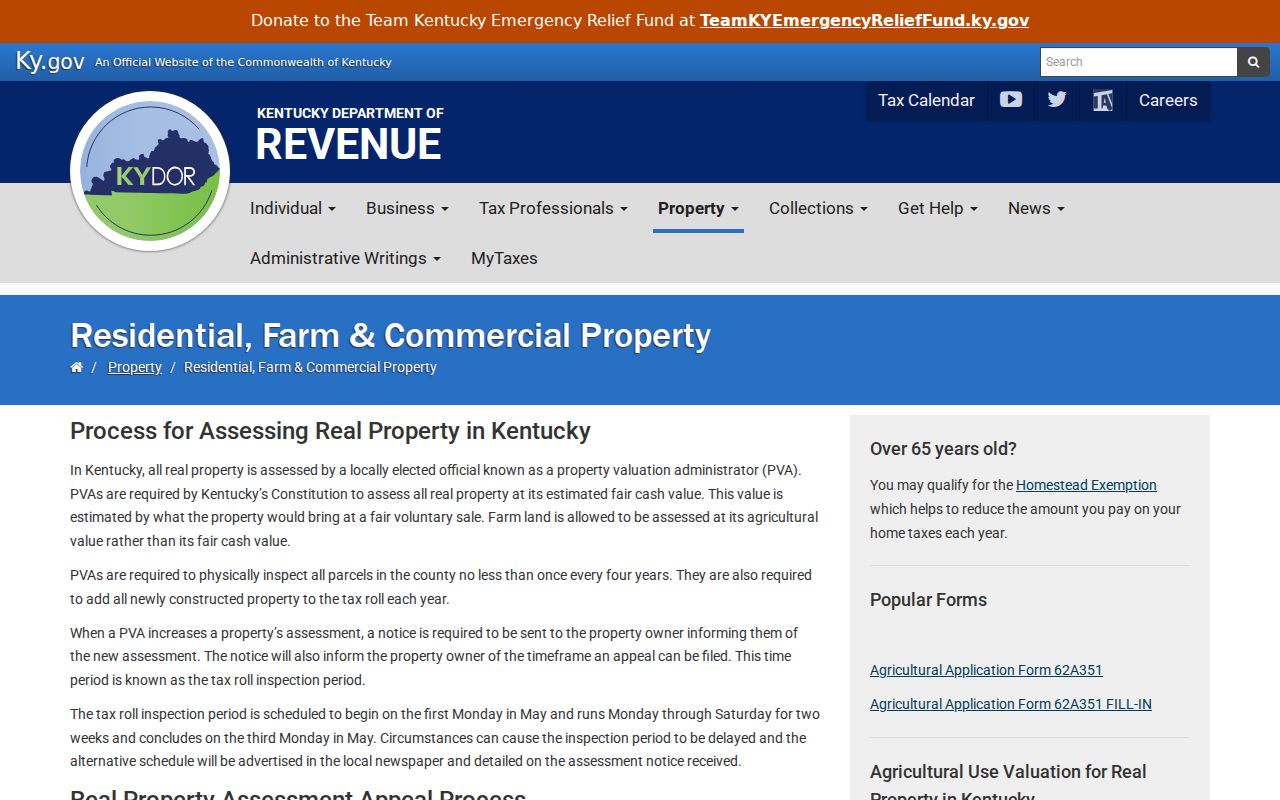
The state page explains the PVA role and the fair-cash-value process. The parcel-specific facts must still come from Lee County.
Lee County Tax Calendar
Property tax records follow a fixed yearly cycle in Kentucky. January 1 is the assessment date. The listing period runs from January 1 through March 1. The roll-inspection cycle opens with a thirteen-day inspection window. It is held six days a week including Saturday. The appeal deadline falls on the next workday. Local dates shift each year, so confirm them before acting.
The Kentucky property tax calendar is the official statewide starting point.
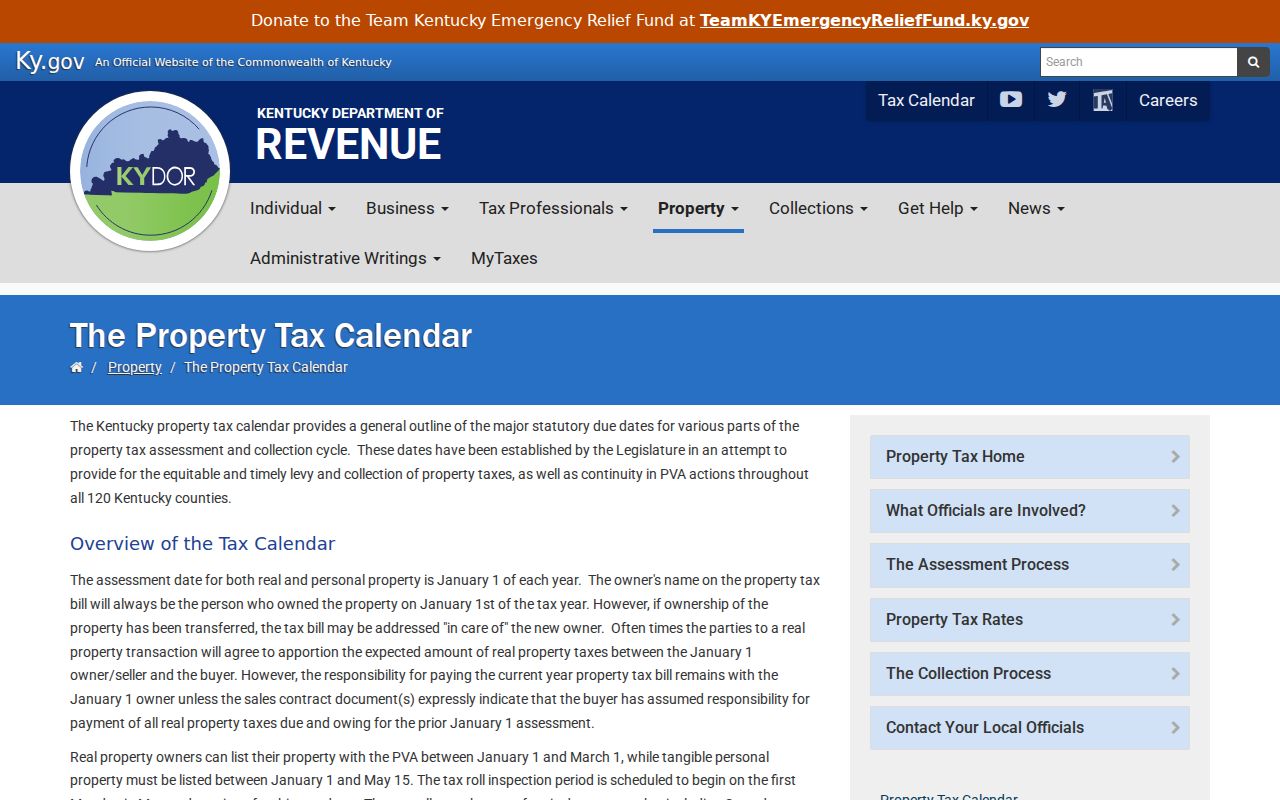
The calendar helps you place an assessment, bill, appeal, and delinquency in order. It is not a Lee County parcel lookup, though. Dates on a statewide calendar only frame the local schedule.
Dated local example: Lee County's 2025 roll notice set inspection for June 2 through June 16 at the PVA office. It also gave local hours and appeal instructions. Those dates show how Lee County published its process that year. They are not the 2026 schedule.
Trace a Lee County Tax Bill
Lee County publishes no online tax-payment or parcel-tax portal. The fallback chain is therefore the useful route. Get the parcel and assessment from the PVA, ask the sheriff or treasurer which office holds the current bill, and ask the clerk about any transferred delinquency certificate. That keeps each office's role clear at every step.
- Give the PVA an exact address or APN and request the card for the correct tax year.
- Contact the Lee County sheriff at (606) 464-4120 or treasurer at (606) 464-2297 for current bill custody, amount, due date, and payment status.
- Compare the taxpayer name with the January 1 owner and note any “in care of” name separately.
- For an unpaid older bill, ask the Lee County Clerk for the certificate number, transfer date, assignment, payment, or release status.
- Assessed value
- The PVA's value for the stated assessment year, based on Kentucky's fair-cash-value standard.
- Homestead exemption
- A statutory program whose current eligibility and appearance on the card must be verified with the PVA.
- Certificate of delinquency
- The lien or certificate created after an unpaid bill transfers from the sheriff to the clerk.
- Taxpayer of record
- The January 1 owner responsible for that year's bill, subject to private contract terms between parties.
Lee County Delinquent Tax Trail
After April 15, delinquent Kentucky bills transfer from the sheriff to the county clerk and become certificates of delinquency. The Department of Revenue delinquent-tax guidance describes one percent monthly interest, a ten percent clerk fee, and a twenty percent county-attorney fee, plus notice, installment, and third-party-purchase procedures. Confirm any balance and status with Lee County first.
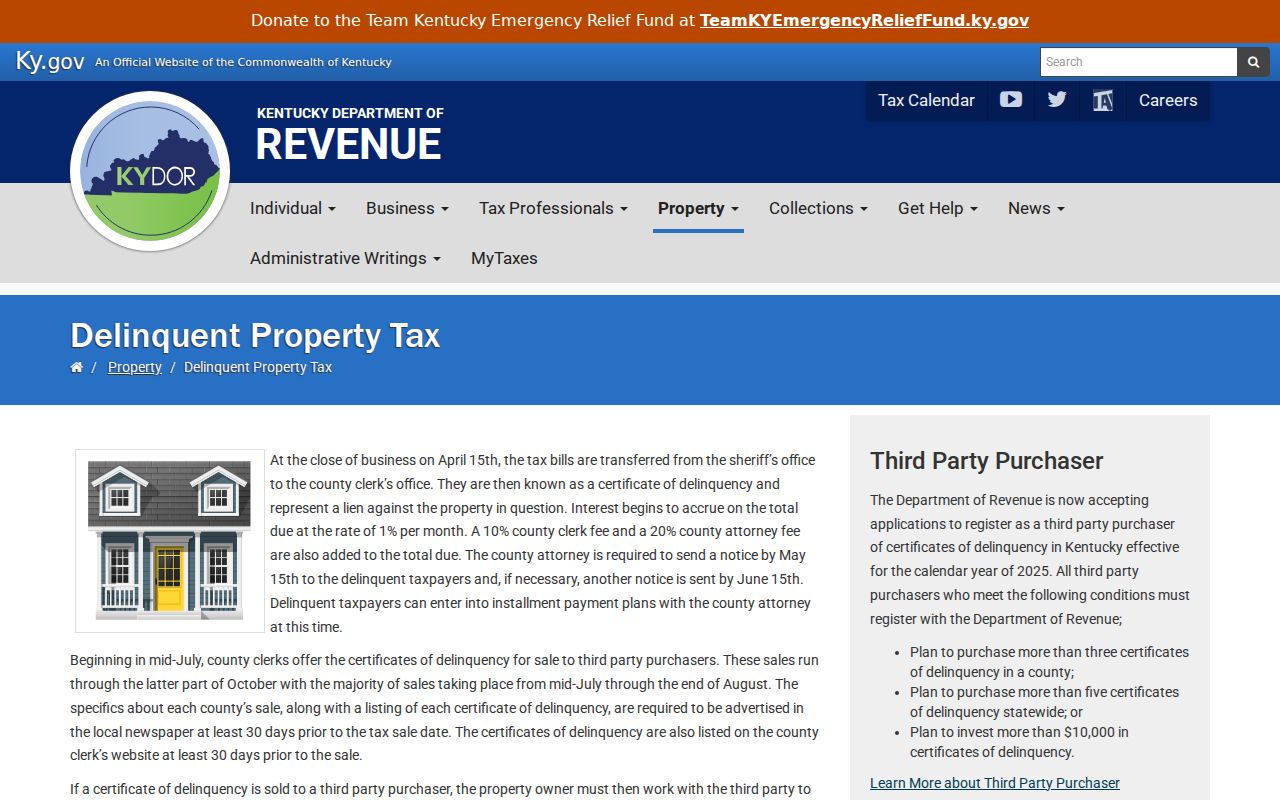
The state guidance explains how the delinquency process works. A current Lee County list, certificate, payment, assignment, or release must still be requested locally.
Do not collapse legal events. A certificate is a lien interest, an advertised sale is notice, and neither alone proves that title changed.
Lee County Taxpayer Timing
A Lee County property tax record can carry an older name right after a sale. The latest deed grantee may not appear yet. Kentucky makes the January 1 owner responsible for that tax year. A later buyer may receive a bill marked "in care of." That display does not rewrite the statutory responsibility. It does not prove deed ownership either. Compare the assessment date, deed date, recording date, and bill year before drawing any conclusion.
A PSC exhibit built on Lee PVA material also carries a warning. Owner and address data may be stale through error or the passage of time. That caution is operational, not a measured local delay. For the legal chain, consult the recorded instrument itself. Do not treat the tax roll as a title opinion.
Contest Lee County Tax Values
Bring an assessment question to the Lee County PVA first. The tax collector cannot change a value. Read the tax roll during the announced inspection period. Keep the parcel card handy. Gather comparable arm's-length sales, photographs, measurements, repair facts, and any land-use papers. DOR recognizes sales comparison, cost, and income as valuation approaches. Qualifying farm land may receive agricultural treatment. A gap between the assessment and a listing price proves nothing by itself.
The appeal clock starts when the inspection period closes. Lee County's 2025 notice used dates later than the usual May pattern. The current local notice controls practical timing. Ask the PVA about inspection dates, the conference process, filing destination, and evidence rules. Do this before the window shuts.
Watch the local notice. Lee County dates vary by year, so confirm the active roll-inspection and appeal deadline with the PVA.
Request Lee County Tax Records
A narrow request works when the web path fails. Give the agency the exact APN, property address, tax year, and the record you want. Ask the PVA for the card and map. Ask the collector for the bill, payments, due date, and status. The clerk handles certificates, assignments, payoffs, releases, and sale-related instruments. Say whether you want inspection or copies.
Kentucky's Open Records Act, KRS 61.870 through 61.884, covers nonexempt agency records. It does not force an office to build a new database. It does not issue a title opinion either. Leave SSNs, account numbers, and other needless personal data out of the request. Leave them out of any saved copy too. The goal may be a value comparison rather than tax status. In that case, the Lee County property value explanation separates assessed, market, and sale figures.
Note: Record the custodian, retrieval date, tax year, APN, and any unresolved gap with every Lee County property tax result.
Route the question to the right stage. The PVA answers assessment-card, class, exemption, acreage, and valuation questions. The sheriff or treasurer can say who holds a current bill. The clerk is the proper route once an unpaid bill becomes a certificate. Court files matter only for a separate judicial case. Keep these channels apart. That stops a clerk's certificate response from being reported as a PVA valuation result.
Describe a "no result" with precision. Record the APN, address, name, year range, source attempted, access problem, and next office. "No record found in the source checked" is accurate. "No tax record exists" overstates the case. The qPublic entry may be blocked, or the local bill portal may fail to verify.
Compare Lee County Tax Evidence
An assessment review works best when every number carries a type and date. Put land value, improvement value, total assessed value, exemption, class, and tax year in one row. Put deed consideration and recording date in another. Add a comparable sale only after checking property type, size, condition, location, access, flood exposure, and utilities. Also confirm the transfer was arm's length.
Skip the assessment-to-sale ratio unless both figures clearly refer to the same parcel. The dates must be useful too. Nominal consideration, family transfers, fiduciary deeds, and distressed events distort the comparison. Label any calculation as research work and keep the sources. Lee County has no verified public neighborhood-value dashboard. So one sale or foreclosure cannot stand in for a countywide trend.